
Three numbers on every JoyaGoo estimate card
A red price, a struck-through price and a Coupon:Save label. Here is how the three relate, what switches them on, and what the card leaves unsaid.
The card as JoyaGoo prints it
Each line in the estimator’s results is a strip with five parts: the carrier logo and line name, a block headed ShippingFee, the estimated transit time in days, a few numbered notes about the line, and a Detail link. Tags such as Free Insurance and Tax Free sit on the logo.
The ShippingFee block always prints in the same order. First comes the red figure in large type, then the struck-through total in small grey type, then an orange label reading Coupon:Save followed by a dollar amount. JoyaGoo’s page code prints the red value first and only adds the struck value and the label when the quote carries them, which is why the red number reads as the price.
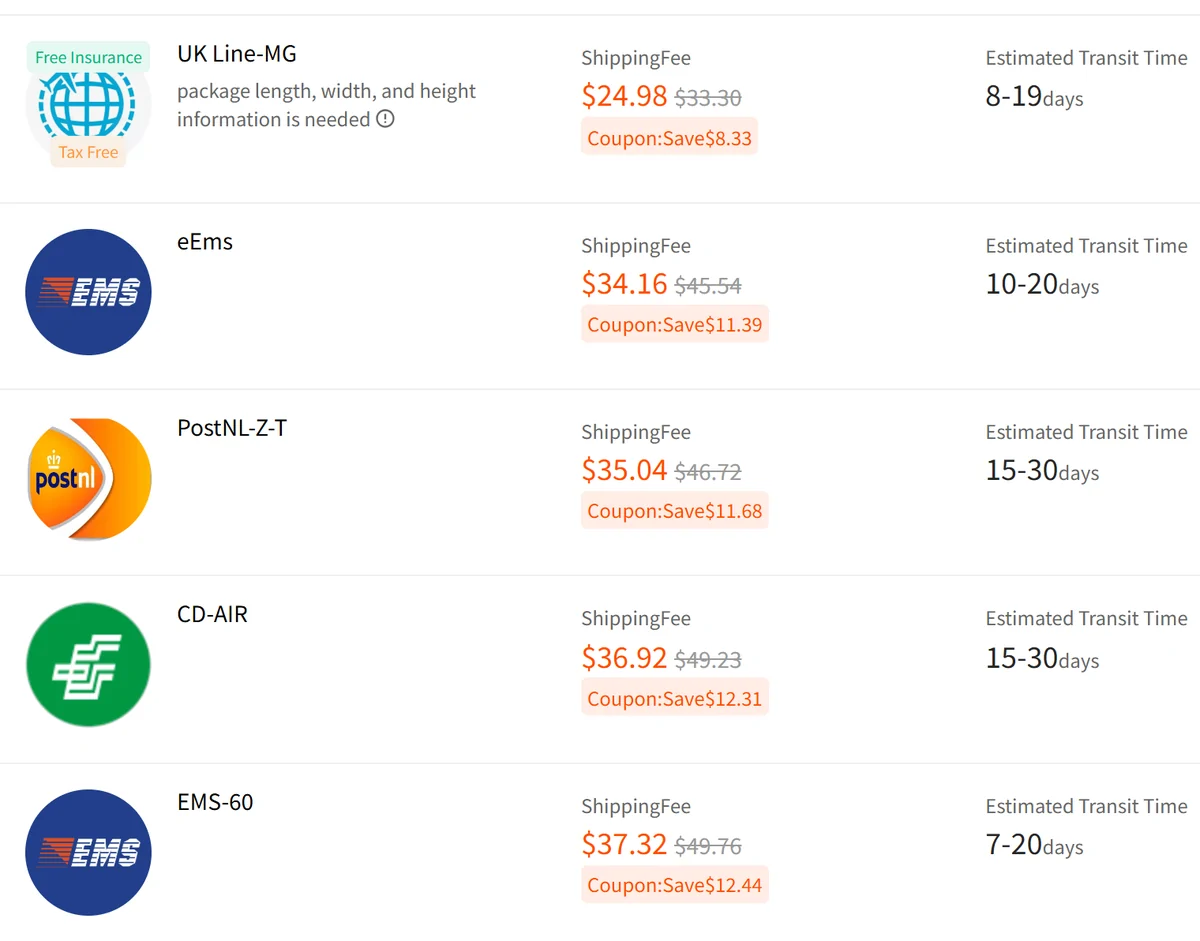
Those five United Kingdom lines, for a 1,000 g parcel on 17 October 2026, run from UK Line-MG at $24.98 red to EMS-60 at $37.32 red. Every one carries a Coupon:Save label worth about a third of its red figure, which is another way of saying a quarter of the struck total.
One ratio across every quote we pulled
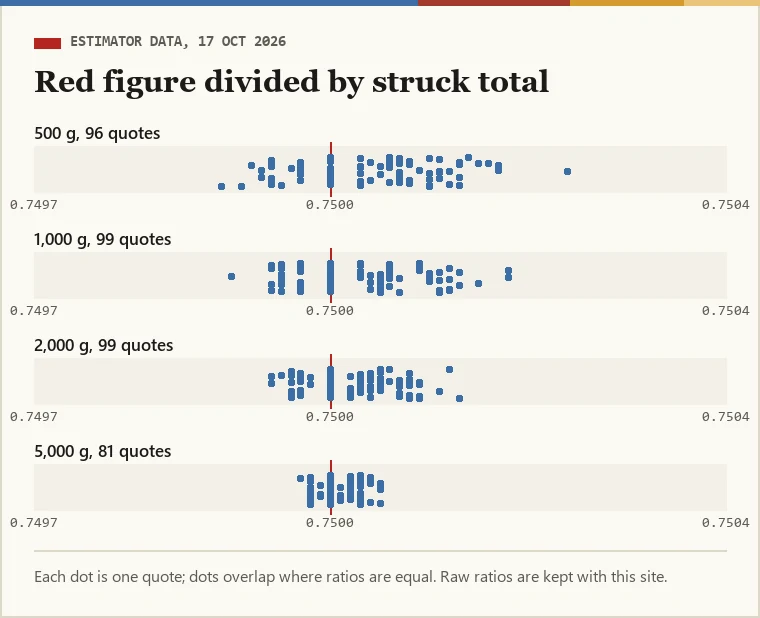
On 17 October 2026 we asked the estimator for 15 destinations at 500, 1,000, 2,000 and 5,000 g, always in a 30 by 20 by 10 cm box. That produced 375 available line quotes. On every one, the red figure divided by the struck total came out between 0.74989 and 0.75024, which is 75% once you allow for rounding to the cent. The spread is a rounding artefact: totals are given in whole cents, so three quarters of them cannot always land on a whole cent.
We also tested the obvious alternative: that the discount applies to freight only and the fixed fees are added back at full price. That reading matched none of the 375 quotes; it would have produced a red figure at least $1.03 higher every time.
So the rule is simple and uniform, and the interesting question is not the ratio but what it is applied to. The audit tool answers that line by line.
The request that switches the coupon line on
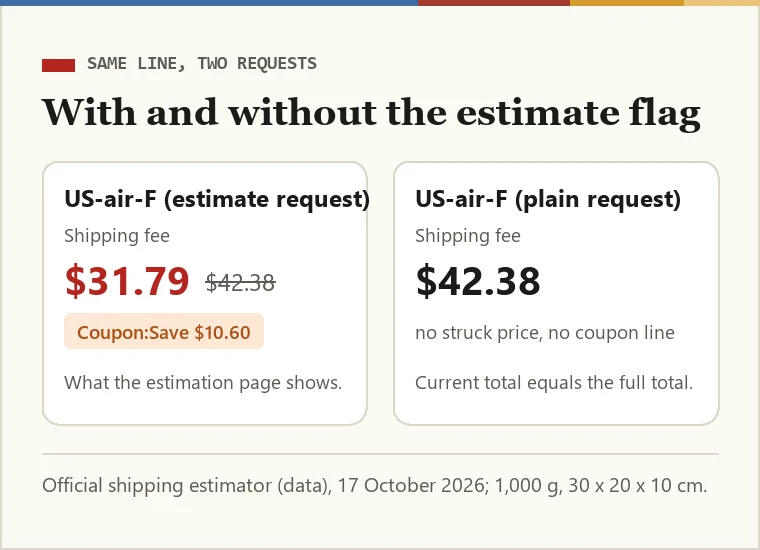
When the estimation page asks JoyaGoo for prices it sends a flag saying the request is an estimate. With that flag the public data comes back with three price fields per line: the full total, a current total at 75% of it, and a maximum coupon discount equal to the difference.
Send the same request without the flag and the current total equals the full total, the struck-through value disappears, and the coupon discount comes back empty. For US-air-F the unflagged response returned $42.38 as the current total, with no separate discounted total or coupon amount. This response comparison does not establish how an unflagged screen would render.
The 25% is therefore a property of the estimate request, not of the line, the parcel or your account. It is the same quarter on a cheap postal line and on an express line, which is a good reason to read it as a display assumption rather than a quoted discount.
The banner above the form
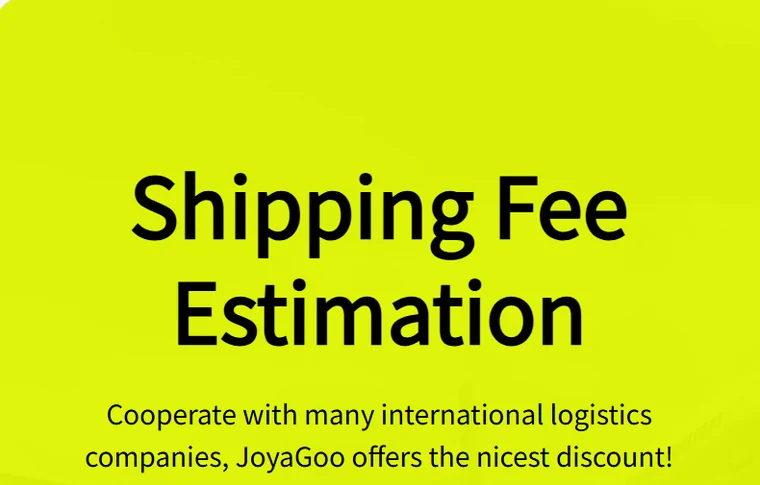
The estimation page opens with a lime panel on the left: the heading Shipping Fee Estimation and the line “Cooperate with many international logistics companies, JoyaGoo offers the nicest discount!” It is a marketing sentence and gives no figure.
Under the form sits a quieter note. It says the lines JoyaGoo does not run itself come from outside carriers who move freight prices with the market, and that JoyaGoo will tell you when a price changes.
Read together, the page promises a discount in words, shows one in red on every card, and warns in small print that the freight underneath can move. None of the three statements says which coupon the red figure assumes.
What sits inside the struck-through number
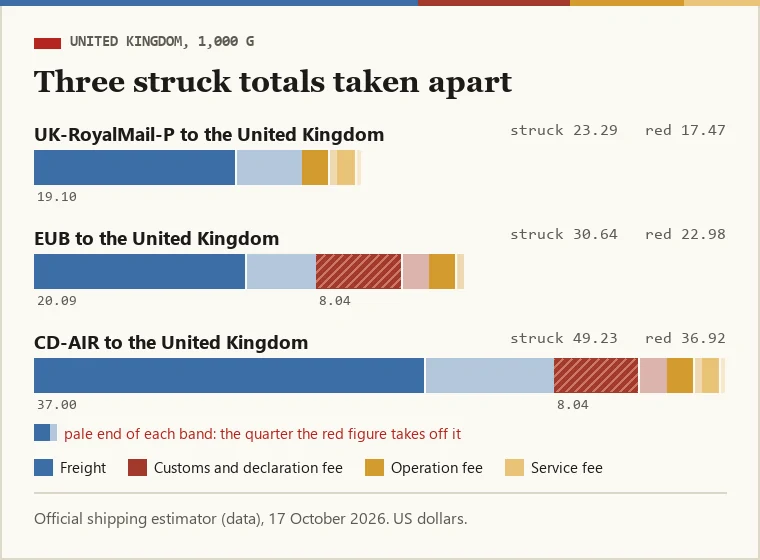
The struck total is the whole shipping quote for that parcel: freight plus whatever fixed fees the line carries. The card itself never shows the parts; you only see them by opening Detail, and even then not all of them, as the fee bands page explains.
Three United Kingdom lines show how different the mix can be. UK-RoyalMail-P is $23.29 struck, of which $4.18 is fixed fees. EUB is $30.64, with $10.55 of fixed fees because it carries the $8.04 customs and declaration fee. CD-AIR is $49.23, including $12.22 of fixed fees.
The red figure takes a quarter off each of those amounts in the same proportion, so the fixed part of the assumed saving runs from $1.05 on UK-RoyalMail-P to $3.06 on CD-AIR. Same parcel, three lines, three different amounts of saving sitting outside freight.
A cent that appears from nowhere
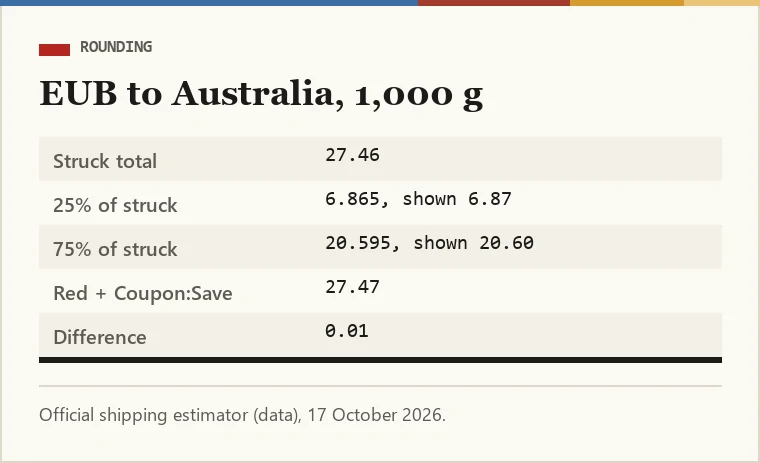
JoyaGoo rounds the red figure and the Coupon:Save amount separately, each to the nearest cent. Most of the time they still add up to the struck total. Sometimes they do not.
EUB to Australia is struck at $27.46. A quarter of that is $6.865, shown as Coupon:Save $6.87; three quarters is $20.595, shown in red as $20.60. Add the two and you get $27.47, one cent more than the total they were cut from.
It is trivial money, but it is a useful tell: the two numbers are calculated from the total independently, not one from the other. When you reconcile a quote, start from the struck figure.
What the card never says about the red number
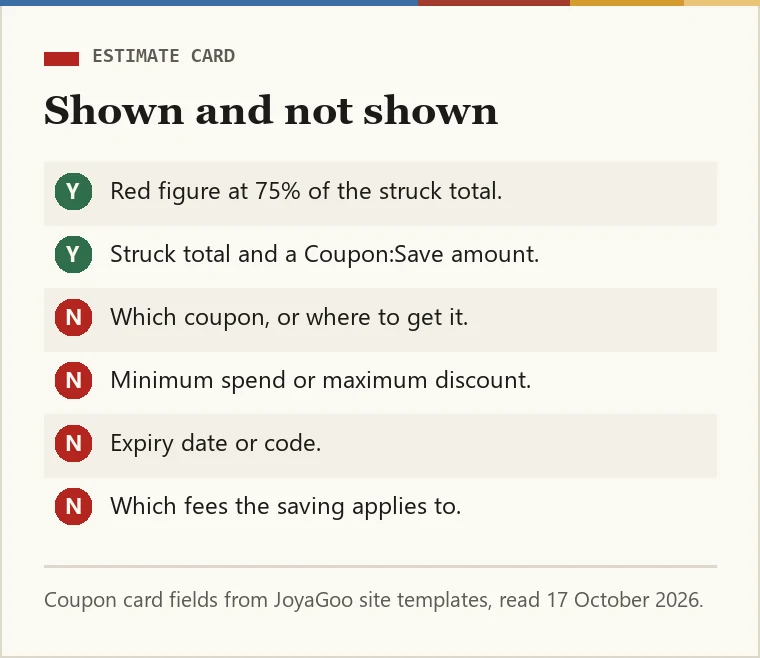
A real JoyaGoo coupon card, per the site’s own templates, shows a minimum spend, a maximum discount on the checkout list, a code, an expiry date and either a fixed amount or a percentage. The estimate card shows none of that.
- It does not name a coupon or say where one comes from.
- It does not mention a minimum spend or a cap.
- It does not say whether your account holds anything that qualifies.
- It does not say which fees the saving applies to.
- The public data calls the amount a maximum coupon discount; the card only says Coupon:Save.
None of this makes the card wrong. It makes it a dated display illustration, not a universal ceiling on real coupon savings. The struck figure is a useful before-coupon estimate for the stated parcel, with optional services, remeasurement and destination charges still to check.
Planning with the struck total
Plan with the struck total. Treat the red figure as the result of this estimator’s assumed quarter reduction. It does not establish what your actual coupon can save or your final landed cost.
JoyaGoo shipping estimatorRun the red-figure auditJoyaGoo home page