
Picking sellers, listings and a spreadsheet site with care
Judgement calls a JoyaGoo order depends on: which spreadsheet sites to trust, which sellers and listings to buy from, and how to compare agents on more than a red number.
Spreadsheet sites: freshness, dead links and who signs them
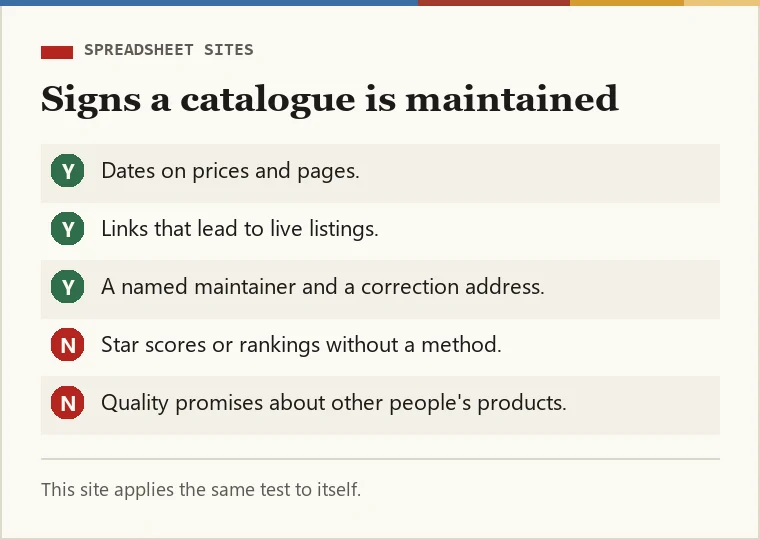
Before you trust any catalogue, including this one, ask three things. Is there a date on it, and is the date recent? Do the links still lead to live listings, or to removed ones? And does anyone sign their name to it, with an address to send corrections?
That is our answer to how to choose a spreadsheet site worth your time. A catalogue that cannot tell you when it was last checked is guessing, and dead links are the quickest sign nobody maintains it. Catalogues that promise rankings, star scores or guaranteed quality are making claims nobody can verify.
Hold us to the same test. Each figure here has a date beside it, the raw data is kept, and corrections go to [email protected].
Seller signals on Taobao, Weidian and 1688
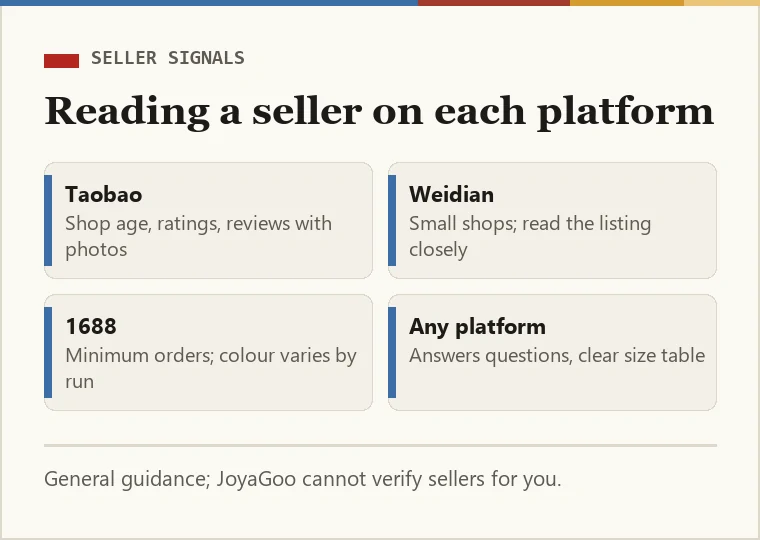
On the marketplaces themselves, how to judge a seller comes down to evidence that other buyers have received what they paid for. Look at the shop’s age and sales volume, read recent reviews with buyer photos, and check whether the seller answers questions on the listing.
Each platform differs. Taobao shops show ratings and long review histories. Weidian is built for small shops, often with little review data, so the listing and the seller’s other items matter more. 1688 is wholesale-first: minimum order quantities are common and colour can vary between production runs.
A good seller still ships to JoyaGoo’s warehouse inside China, so seller speed affects how soon your item is Stored and your 90 free storage days begin.
Comparing agents on more than one number
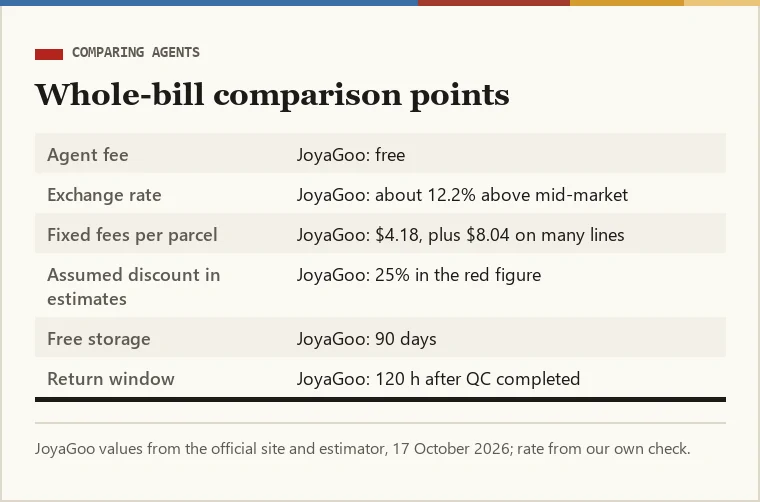
If you are deciding how to choose an agent, compare whole bills, not headline prices. That means the agent fee, the exchange rate the site applies, the fixed per-parcel charges in its shipping quotes, insurance terms and storage time.
Shipping estimates are the trap. One agent’s lower number may include an assumed coupon, another’s may be the full price. JoyaGoo’s red figure assumes a quarter off everything; its struck total is the number to compare with another agent’s full quote.
Also compare how each agent handles problems: return windows, claim deadlines, what happens to a failed delivery, and whether its rules are dated and published.
Deciding what to order, item by item
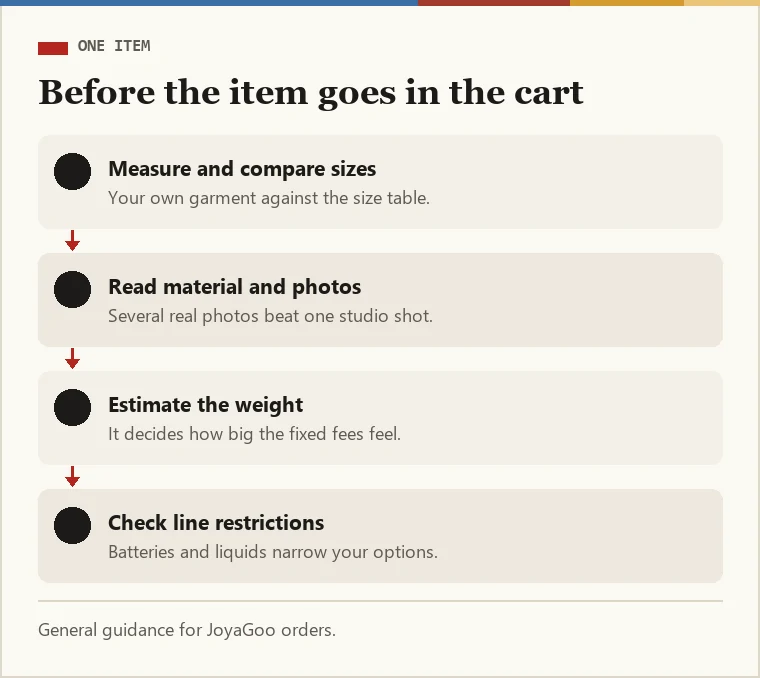
Deciding what to order is mostly about removing doubt before you pay. Measure a garment you own and compare it with the seller’s size table. Read the listing’s material line. Prefer listings with several real photographs over a single polished image.
Consider weight early. A light item shipped alone carries the same fixed fees as a heavy one, so its shipping cost per item is high; a heavy item shifts the bill toward freight. Neither is a reason to buy more than you want.
Check the line restrictions for the item type. Batteries, liquids and some accessories are refused on many lines, which can leave you with few or expensive options. The Detail panel on each estimator line lists what that line refuses.
If a listing offers several sizes or colours at different prices, the price on a catalogue card may belong to an option you do not want; check the price after choosing.
Habits that keep the shipping bill honest
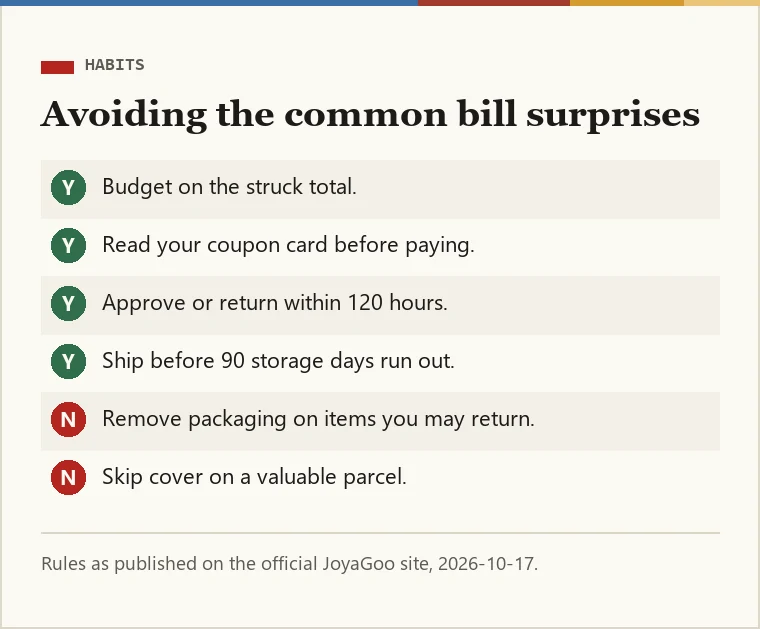
A few habits save more than any coupon. Watch out for these in particular, because each one turns a reasonable estimate into a disappointing bill.
- Planning on the red figure instead of the struck total.
- Assuming a coupon covers the customs and declaration fee when its card says otherwise.
- Forgetting the 120-hour return window after QC completed.
- Leaving items past 90 days of free storage.
- Removing packaging to save weight, then wanting to return the item.
- Choosing a line without free insurance and skipping paid cover on a valuable parcel.
Each of these is in JoyaGoo’s own published rules; none needs inside knowledge to avoid.
Seller first, parcel last
Judge the seller, then the listing, then the parcel. The audit tool helps with the last step.
JoyaGoo shipping estimatorRun the red-figure auditJoyaGoo home page